Premium fragrance manufacturing is a scope, not an adjective. The word high-end describes a set of capabilities that show up in specific places: how incoming materials are controlled, how a small batch is run without losing the perfumer's intent, how decoration and assembly are quality-gated, and how much of the compliance file travels with the goods. An established beauty brand evaluating a premium claim should test those four areas directly, because most suppliers can produce a fine fragrance and far fewer can hold its specification across a seasonal run. The checklist below is the version we would take into a supplier meeting.
Key takeaways
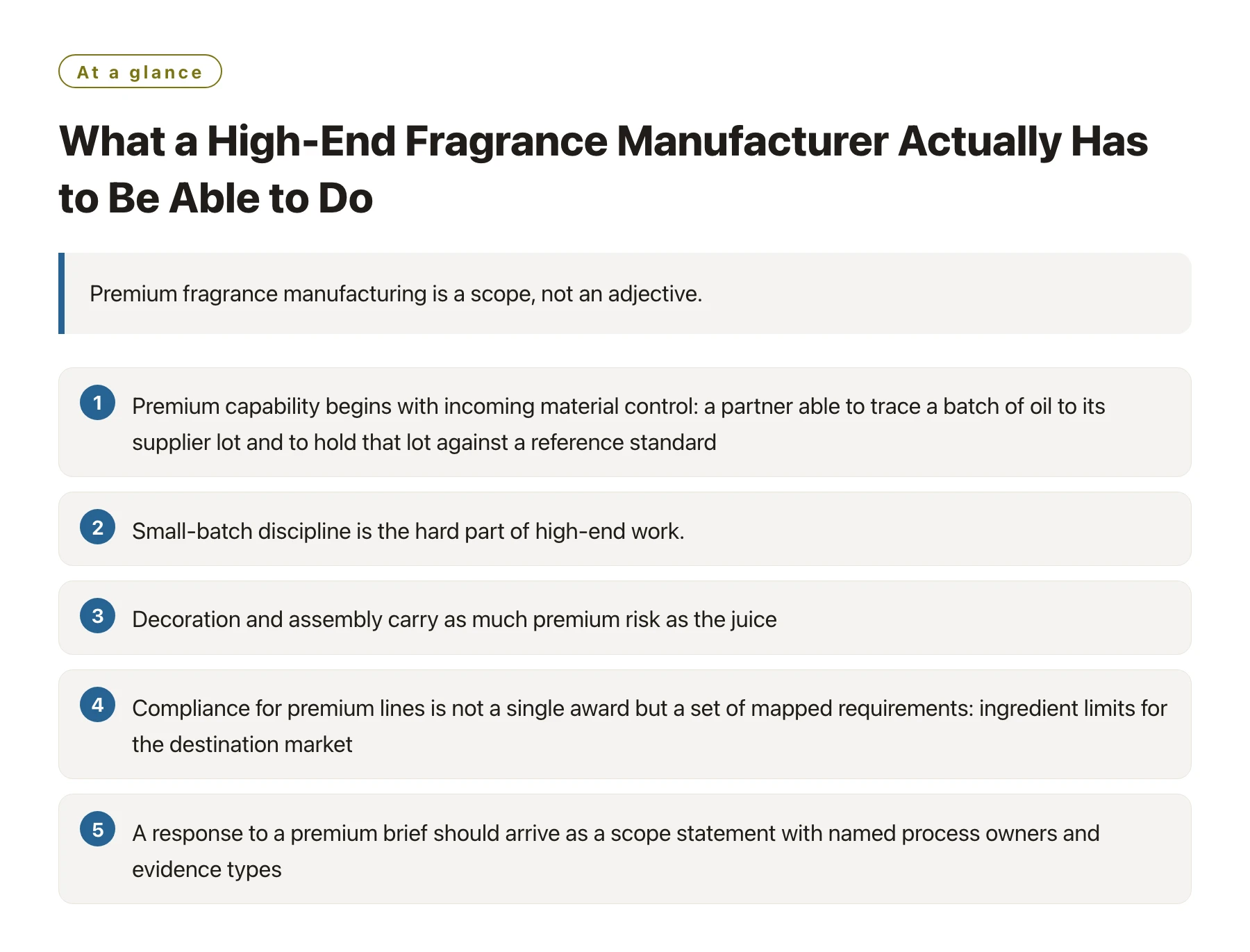
- Premium capability begins with incoming material control: a partner able to trace a batch of oil to its supplier lot and to hold that lot against a reference standard, rather than relying on a certificate of analysis and a smell test.
- Small-batch discipline is the hard part of high-end work. The ability to run limited quantities repeatedly, without reformulating around minimum quantities, is what separates a genuine fine fragrance line from a volume operation that occasionally accepts small orders.
- Decoration and assembly carry as much premium risk as the juice; coating, metallisation, crimping and weight control decide whether a bottle feels expensive or merely looks expensive in a photograph.
- Compliance for premium lines is not a single award but a set of mapped requirements: ingredient limits for the destination market, labelling rules for allergens, and packaging documentation for whatever recycling regime applies. [1]
- A response to a premium brief should arrive as a scope statement with named process owners and evidence types, not as a capability brochure listing machinery.
- Price and premium are not the same axis. Two quotes at the same unit cost can differ entirely in what is included, which is why scope comparison has to happen before price comparison.
Every fragrance supplier with a fine fragrance line describes itself as high-end, and the word carries no defined meaning. That leaves buyers with two bad options: trust the impression created by a website, or build an internal definition and test against it.
This article takes the second route. It is written for product and sourcing teams at established beauty brands, the kind that already ship fragrance and are now moving into a price tier where consistency matters more than the first purchase price.
The four capabilities the word premium is hiding
Material control and traceability
Ask how an incoming oil is verified against a retained reference, what happens when a lot drifts, and who signs the release. Traceability from supplier lot to finished batch is what allows a defect investigation to conclude something, and it is the first capability that volume-focused factories skip.
Small-batch production without reformulation
A premium line often ships in quantities that are awkward for a big factory. The test is whether the same formula can be run at those quantities with the same filling line and the same resting or maceration practice, or whether the scent is quietly adjusted to fit a larger minimum batch.
Decoration and assembly control
Coating adhesion, metallisation depth, print alignment, crimp height and fill weight all have tolerances, and premium quality is a matter of holding them run after run. Request the tolerance table rather than a sample bottle; a supplier who has one has already done the work.
Documentation that travels with the goods
Ingredient limits for the destination market, allergen labelling and packaging documentation are market-specific requirements. [1] A premium supplier should be able to say which requirements apply to your product category and which do not, instead of sending a folder.
Scope checklist: ask for these before you compare quotes
| Scope area | Evidence to request | Why the answer changes the price |
|---|---|---|
| Juice specification | Signed specification with dosage and reference standard per accord | Defines what is being repeated in every later batch |
| Batch holding | Retained samples per batch and the retention period | Makes drift detectable rather than discovered by customers |
| Filling and assembly | Fill-weight tolerance, crimp specification, line qualification | Explains why two suppliers quote different unit costs on the same bottle |
| Decoration | Tolerance table plus adhesion and abrasion test results | Decoration failures are the most common visible defect at retail |
| Stability and compatibility | Hot-cold cycling and compatibility data with the chosen pack | Prevents a reformulation request after tooling is paid for |
| Compliance pack | Allergen labelling to the destination market, restricted-material statement | Ties the market and the category to the documents that support the claim [1] |
| Scale-up plan | Named owner for the sample-to-bulk transition plus acceptance criteria | Determines who is accountable when bulk differs from the approved sample |
Nothing in this table is exotic. Each line is a normal document for a high-end fragrance manufacturer that runs fine fragrance at a premium tier, and their absence is not proof of poor intent - only of where the burden of supervision will fall.
How premium work behaves on the production line
On the line, premium production shows up as slower, better-instrumented steps rather than as different chemistry. Batch documentation is completed as the batch runs, not reconstructed afterwards. Filling is checked by weight at intervals short enough to catch drift before a pallet is complete. Decoration is inspected against a limit sample that both sides signed.
It also shows up in how deviations are handled. The useful question is not whether a supplier has ever had a defect, since every line does, but what happened after it. A supplier that can describe a deviation, the containment action and the change it made to the process is describing a quality system. One that answers that its products are always perfect is describing a sales process.
Labels and artwork are where premium lines most often lose their polish. It is worth asking which changes a buyer may make to artwork without requalifying the packing line, and how a labelling revision is controlled once the first order has shipped. [2]
Take the checklist into the meeting as a table to be filled in, not as a questionnaire to be answered verbally. Ask the supplier to mark each line as documented, available on request, or not applicable, and to name the person who owns it. Where the response is mostly verbal, look at how quality control in luxury fragrance production is described by a manufacturer that runs the category, and use that description to calibrate how much detail a real answer contains.
The trade-offs a premium claim does not remove
Higher tier capability does not remove cost pressure; it relocates it. A partner that controls materials tightly will charge for retention samples, stability work and line qualification, and those costs are real rather than padding. The practical question is whether each item is priced separately so the brand can decide what its own positioning needs.
The same applies to flexibility. A manufacturer set up for premium consistency is often less able to absorb a late packaging change than a generalist, because its process assumes locked specifications. Established brands should decide early which of the two they need more, and write that priority into the brief. A manufacturer that supports both OEM and ODM routes will usually be explicit about which decisions are frozen when, and that clarity is worth more than a broader capability list.
Finally, premium positioning does not exempt a brand from the ordinary disciplines of fragrance sourcing: a complete brief, a written specification, agreed tolerances and a documented pre-shipment check. Those are what make a high-end claim true at the pallet, and no supplier can supply them on the brand's behalf.
Sources
- European Commission: Cosmetic Products — Specific Topics —— EU pages covering specific cosmetics topics such as product claims, nanomaterials and animal-testing rules.
- European Commission: Cosmetics in the EU —— The European Commission's overview of EU cosmetics rules, including the responsible person, product information file and safety report requirements.
Frequently asked questions
How can I tell whether a fragrance manufacturer is genuinely high-end?
Test four areas with documents rather than impressions: incoming material traceability, small-batch repeatability, decoration tolerance control, and market-specific compliance mapping. A supplier that can produce a tolerance table, a retention sample policy and a written scale-up plan is demonstrating premium capability. One that can only show machinery and finished bottles is showing capacity instead.
Is a high-end fragrance manufacturer always more expensive?
Usually the unit cost is higher, but the comparison is rarely like for like. Premium scope often includes stability work, retention samples and line qualification that a cheaper quote leaves out. Normalise both quotes to the same scope before deciding, and expect the gap to narrow.
What compliance documents should a premium fragrance line hold?
At minimum: an ingredient-limit statement for the destination market, allergen labelling consistent with that market's rules, restricted-material declarations from the fragrance house, and packaging documentation for the recycling regime that applies. Which items apply depends on category and destination, so ask the supplier to map each requirement to your product rather than sending a folder.
Does premium production require a minimum order quantity?
It usually involves one, because small batches carry setup, cleaning and line-qualification cost. The useful question is not whether an MOQ exists but how it is calculated and whether the same formula can be produced repeatedly at that quantity without reformulation.
What is the biggest scope item buyers forget to price?
The sample-to-bulk transition. Line qualification, first-article approval and any decoration trials sit between an approved sample and a shippable pallet, and they are frequently assumed to be included. Ask for them as named line items so the real cost of the tier becomes visible.