Two Days of Hourly Payouts: Tracking 1 PH/s as It Settles
Hourly settlement turns a weekend of mining into a staircase you can audit line by line. At 1 PH/s the pool credits about 0.00001869 BTC each hour, so 48 hours stack to 0.00089721 BTC, worth $75.99 at $84,692 per coin. This piece follows that climb in eight-hour checkpoints and shows how to match each step against a wallet balance.

Key takeaways
- 1 PH/s earns 0.00044861 BTC a day, which divides into 0.00001869 BTC per hour.
- After 24 hours the running total is 0.00044861 BTC; after 48 hours it is 0.00089721 BTC.
- The 48-hour stack is worth $75.99 at the $84,692 BTC price read 21 Sept 2026.
- Each eight-hour checkpoint should add close to 0.00014954 BTC when uptime is continuous.
The ledger habit: why checkpoints beat month-end math
Most miners reconcile monthly, notice a gap, and then guess where it came from. A checkpoint habit works the other way: write down the expected cumulative total at fixed hours and compare it with the wallet the same evening. When the two series agree within a percent or two, the operation is healthy. When they diverge, the hour of divergence points at the cause, whether downtime, a hashrate dip, or a difficulty change.
Hourly PPS+ settlement makes this practical because the credit rhythm is fixed against current difficulty. There is no waiting on block confirmations for the block-reward slice, no luck factor to smooth out, and no weekly averaging to hide a bad Tuesday. Six confirmations and the last-five-rounds window belong to PPLNS accounting, a different system with its own variance; the staircase in this article is the PPS+ default, hour by hour.
How the 48-hour staircase is built
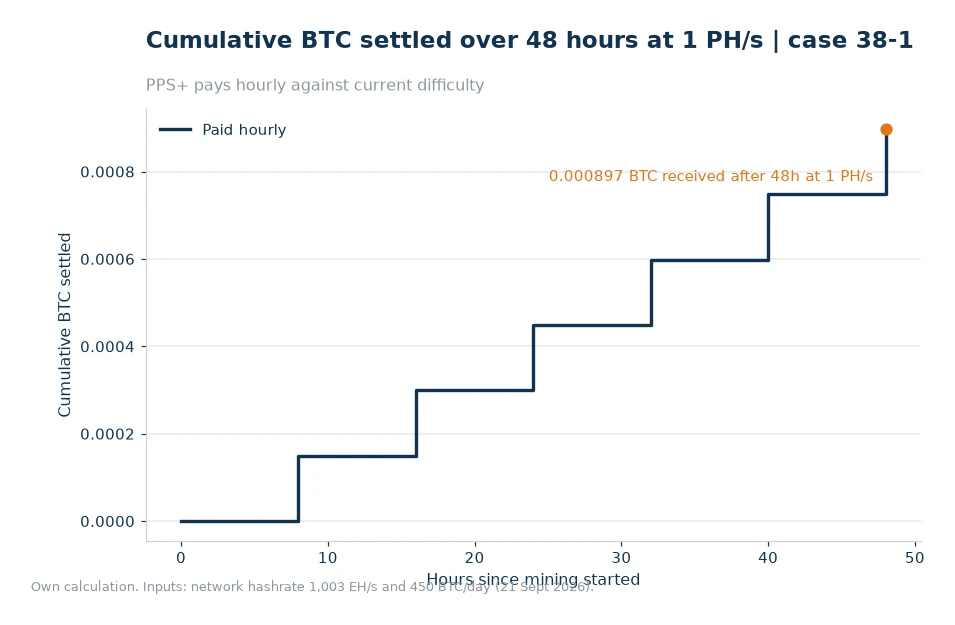
The foundation is the network division: 1 PH/s equals 1,000 TH/s against about 1,003 EH/s network-wide, with 450 BTC issued per day from 144 blocks at 3.125 BTC each. That gives 0.00044861 BTC a day, and dividing by 24 gives the hourly rung of 0.00001869 BTC. Multiply by elapsed hours and the staircase rises: 0.00014954 BTC at hour 8, 0.00029907 at hour 16, 0.00044861 at the one-day mark.
The second day repeats the first with metronome regularity. Hour 32 reads 0.00059814 BTC, hour 40 reads 0.00074768, and hour 48 closes at 0.00089721 BTC. Converted at $84,692, the one-day mark is worth $37.99 and the full run $75.99. Keep those two dollar anchors in mind; they are the fastest sanity check when scanning a payout history on a phone screen.
Matching pool credits to the wallet balance
Credits and wallet arrivals are two different events, and conflating them causes most reconciliation headaches. The pool ledger records each hourly credit the moment it settles; the ViaBTC Crypto Wallet balance reflects what has been transferred, held, or converted afterward. Auto Conversion, for instance, can swap part of the inflow into another coin, which changes the BTC-denominated balance without changing what the pool paid.
The fix is to reconcile credit history against credit history first. Export or screenshot the pool-side payout log for the 48-hour window, add the hourly lines, and confirm the sum lands near 0.00089721 BTC. Only then compare with the wallet, where zero-fee mining payouts mean the transfer itself should not shave the total. If the pool side matches and the wallet side trails, the difference sits in transfers, conversions, or timing rather than in missing earnings.
What a shortfall at one checkpoint usually means
A checkpoint that lands light by an hour or two of credit almost always traces to uptime. A firmware restart, a pool-side reconnect, or a brief power cut removes exactly the hours it lasts, and the staircase resumes its slope afterward instead of catching up. Because PPS+ pays for shares submitted while hashing, idle time is simply absent from the sum; there is no backlog paid later.
A shortfall spread thinly across every checkpoint points elsewhere: effective hashrate running below nameplate, a difficulty increase mid-window, or rejected shares from an unstable connection. Check the miner-reported rate against the pool-reported rate for the same hours. A persistent 5% gap between the two is a networking or hardware issue worth chasing, while a sudden step down on a known difficulty-adjustment date is just the network repricing the day rate.
Weekend power pricing adds another wrinkle worth logging beside the checkpoints. Some tariffs dip overnight or on Sundays, which never changes the BTC staircase but does change the dollar margin behind each rung. Note the tariff next to each checkpoint row for a month and the cheapest hashing hours reveal themselves. The habit costs one extra notebook column and pays for itself the first time a schedule shift moves load into cheaper hours.
Tools that keep the two-day audit honest
Two pool pages do most of the work. The pool status page shows live Pool Hashrate and difficulty context, so you can confirm the network inputs behind your expectation before blaming the rig. The statistics view adds miner counts and longer trends for anyone who wants to see whether a hashrate dip was local or pool-wide.
For forward planning rather than backward auditing, the Profit Calculator restates the same division in dollars at current difficulty, including the merged-mining output where applicable. Use it at the start of the month to set the expectation, then let the checkpoint table judge the reality. Expectation first, evidence second, and adjustments only when the two disagree twice in a row.
| Checkpoint | Running BTC total | Running USD value | Added since prior checkpoint |
|---|---|---|---|
| Hour 8 | 0.00014954 | $12.66 | 0.00014954 BTC |
| Hour 24 | 0.00044861 | $37.99 | 0.00029907 BTC |
| Hour 40 | 0.00074768 | $63.32 | 0.00029907 BTC |
| Hour 48 | 0.00089721 | $75.99 | 0.00014953 BTC |
Notice the symmetry: the middle sixteen-hour stretches each add 0.00029907 BTC while the eight-hour bookends add half that. That pattern is the signature of uninterrupted hashing at a fixed difficulty, and any real-world ledger that deviates from it carries information. A light middle stretch means daytime downtime; a light final stretch means the fault happened last night.
Worked example
Take 1 PH/s and rebuild the full 48-hour staircase from the network inputs, converting to dollars at the end.
- Convert hashrate: 1 PH/s = 1,000 TH/s = 1,000,000 GH/s.
- Daily BTC: 1,000 × (450 ÷ 1,003,000,000) = 1,000 × 0.00000044865 = 0.00044861 BTC.
- Hourly credit: 0.00044861 ÷ 24 = 0.00001869 BTC.
- Hour 8: 8 × 0.00001869 = 0.00014954 BTC, worth 0.00014954 × 84,692 = $12.66.
- Hour 16: 16 × 0.00001869 = 0.00029907 BTC.
- Hour 24: 24 × 0.00001869 = 0.00044861 BTC, worth $37.99.
- Hour 32: 32 × 0.00001869 = 0.00059814 BTC; hour 40: 40 × 0.00001869 = 0.00074768 BTC.
- Hour 48: 48 × 0.00001869 = 0.00089721 BTC, and 0.00089721 × 84,692 = $75.99.
Frequently asked questions
Why do my 48 hours show slightly less than 0.00089721 BTC?
Uptime is the usual answer. Every offline hour removes about 0.00001869 BTC from the staircase, so two hours of downtime leaves roughly 0.00085983 BTC; the listed fee slice on each component accounts for the remainder.
Should I compare the pool log or the wallet first?
Start with the pool-side credit history and confirm it sums near 0.00089721 BTC for the window. Then check the wallet, where transfers, Auto Conversion, or timing can explain any further gap under zero-fee mining payouts.
Does a difficulty change mid-weekend break the staircase?
It bends it slightly. PPS+ settles against current difficulty, so a move near the −2.12% estimate shifts the hourly rung by a similar percentage from the adjustment onward without touching earlier credits.
File the weekend, then forget it
A two-day audit should end in a single filed note: expected 0.00089721 BTC, received a figure within a percent of it, variance explained or flagged. When the next weekend matches again, the habit has paid for itself: attention moves from daily balance-watching to the exceptions that actually cost money, like degrading boards and creeping reject rates.
Keep the confirmation routine light. Glance at live hashrate mid-week, re-run the dollar conversion when the BTC price moves, and save the full checkpoint comparison for month-end. Steady staircases need no supervision; only broken ones deserve an evening.
Sources: the ViaBTC wallet, pool status, and fee pages for settlement rhythm and listed rates, with chain inputs cross-checked on public explorers[1]. Chain data read 21 Sept 2026: network hashrate 1,003 EH/s, difficulty 132.76 T, 3.125 BTC per block, 144 blocks a day, BTC $84,692. Figures published 11 Nov 2026; totals assume continuous hashing at 1 PH/s.